RECENT PUBLICATIONS |

Pressed But Not Free
Filipino journalists fight a war on two fronts, and they cannot win it alone.
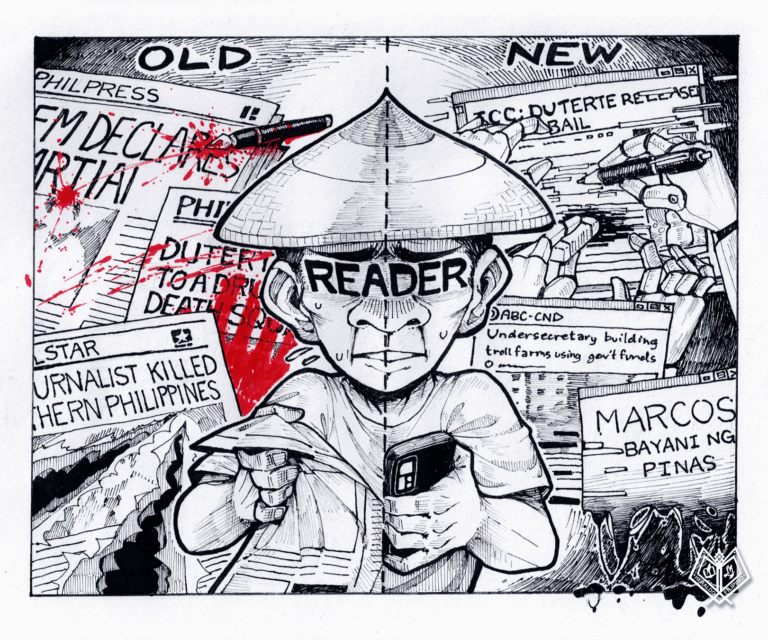
They stand as inheritors of courage earned in blood—of reporters who chose exile over silence when Ferdinand Marcos padlocked every newspaper on September 21, 1972. That legacy of resistance against tyranny still echoes in today’s newsrooms. But now, they also pioneer through uncharted territory: a digital battlefield where algorithms reward lies over facts, troll armies weaponize doubt, and truth dies not from a dictator’s decree but from a thousand coordinated cuts.
The paradox of Philippine journalism in 2025 is this: honor the martyrs of Martial Law while mastering survival tactics against enemies those heroes never could have imagined. The typewriters that once defied dictatorship have given way to keyboards fighting algorithms designed to bury democracy beneath manufactured noise.
In this dual battle for truth itself, press freedom becomes everyone’s fight.
With the Philippines ranking ninth in the Committee to Protect Journalists’ (CPJ) impunity index for 2024, the numbers reveal an unfinished revolution, holding this grim distinction for 17 consecutive years as killings go consistently unsolved. Since President Ferdinand “Bongbong” Marcos Jr. assumed office, five journalists have been killed, punctuating a broader pattern that recorded 184 cases of attacks against media workers—a 44 percent increase over the previous administration. Each statistic represents not just a life lost or threatened, but a warning sent to every reporter who dares speak truth to power.
Violence represents only the visible edge of a more sophisticated assault. Red-tagging, surveillance, cyber libel cases, and even strategic lawsuits against public participation drain resources and transform journalists from watchdogs into hunted prey. Economic pressure may prove the most corrosive force of all. When 44 percent of journalists earn below P15,000 monthly, and when 70 percent must take additional jobs to survive, press freedom becomes a luxury many cannot afford. Some photographers accept as little as P75 per image. For many, survival means side jobs or dependence on sponsors, eroding the very independence journalism demands.
The digital revolution promised democratization but delivered chaos. Algorithms reward outrage, influencers shape discourse without ethical guardrails, and disinformation spreads faster than facts. During elections, lies went viral while fact-checkers fought losing battles. Artificial intelligence (AI) now supercharges these campaigns, turning technology into another weapon against truth.
Campus journalists, supposedly protected by Republic Act (RA) 7079, face the same harassment as professional media, yet the law remains toothless in providing real protection.
These student publications become laboratories for testing press freedom limits, training grounds where tomorrow’s journalists learn whether truth-telling will be rewarded or punished.
National Press Freedom Day exists by statute, yet attacks continue, revealing the gap between symbolic gestures and substantive protection.
Press freedom is not a journalists’ issue but a democratic imperative requiring collective defense. Violations against journalists presage broader assaults on citizens’ rights. The global dimension became visible in citizen journalism covering Gaza, where ordinary users realized that silencing press anywhere threatens information freedom everywhere.
The path forward requires acknowledging that journalists cannot win this battle alone. Citizens must learn to distinguish between legitimate reporting and manufactured content, support quality journalism, and defend the truth as their own.
The martyrs of Martial Law died for transparency; contemporary journalists risk their careers and lives for the same principle. Their struggle belongs to all who believe power should answer to the people it serves.
National Press Freedom Day arrives as a call to conscience. The question is not whether journalists will continue fighting—history proves they will. The question is whether Filipino society will fight for them.
The typewriters may have given way to keyboards, but the essential battle endures: truth against power, transparency against corruption, courage against the machinery of silence. This battle belongs to all of us, for in its outcome lies the future of Philippine democracy itself.
Truth survives only if we defend it together.