RECENT PUBLICATIONS |

When curation becomes censorship
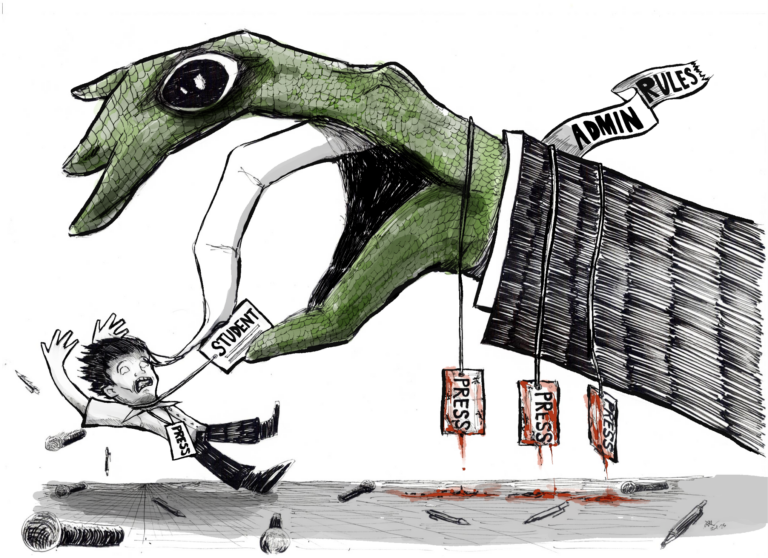
Institution channels for information should empower the community—not filter it to protect reputations. Yet at DLSU-D, the line between “curating” and censoring has grown increasingly hard to see.
Much of this directly challenges the Publication, but beyond that, it is a shared struggle whispered in secrecy among students for fear of being called out, or worse, sanctioned for speaking up.
A clear example of this is the Student Development and Activities Office (SDAO)’s Guidelines for Communication Protocols, Public Statements, and Social Media Management, which require student leaders to secure administrative review prior to releasing any official statement. At a time when campus and national concerns demand louder voices, this risks quieting those who cannot afford disapproval.
While the University frames this as standard procedure, the what ifs remain: What if a statement fails to secure approval? Where does it go? Who gets to speak? What has become quite apparent is that—without approval, these voices will go unheard.
This tightening grip on student expression mirrors past apprehensions within the University. During the 38th EDSA commemoration, security forces ordered student activists to take down a banner simply expressing a stance against Charter change. Student leaders who criticized administrative lapses during a mobilization in front of Magdalo Gate (Gate 1) were reportedly summoned with their parents. And when now-resigned University Student Government (USG) President John Andrei Vito spoke about “bureaucratic delays” that hindered Martial Law commemoration events during his State of the University Student Government Address (SUSGA) last September 29, the Office of Student Services (OSS) took swift action to publicly condemn him for speaking his truth.
We have seen this pattern before.
The HERALDO FILIPINO carries the burden of information, and the feeling of being watched and warned over its releases has created a historical pattern of repression. The anxiety of being summoned for reporting stories that “might go against the University’s favor” has been passed on from one Editorial Board to another.
We have been told to slow down discussions on the University’s loss of autonomous status, to stop posting low board exam performance results, and to delete reports because they were “not good for the University’s image.” We have been questioned who approved our posts, who wrote the articles, and why we published critical information. We experienced administrators refusing to provide statements unless we grant requests to review article drafts—against our editorial independence. Even simply reporting local government unit (LGU)-mandated class suspensions bears risk.
Warnings masked as reminders follow whenever we report stories that challenge comfort or reputation. When we published an article about substandard parking spaces, a story detailing students’ campus experience, offices took offense for not “getting their side.”
Over time, it has become apparent that whenever information places the University in an unflattering light, the instinct is not to correct the issue but to question why it was reported.
We have reached as far as receiving commands to take down factual reports—alarmingly setting press freedom at risk. These practices contradict the very principles of a free student press.
We have been told that “press freedom has its limits,” but these limits must never be used to shield institutions from criticism. The press does not magically conjure stories out of thin air: they arise from long-standing concerns that remain unaddressed.
The pressure to sanitize information only deepens the mistrust it seeks to prevent. If student leaders are expected to take accountability, so must administrators. The University must be accountable to its students, who have every right to demand to be heard.
For such a long time, this larger threat has built through bureaucracy that discouraged students from speaking up. Some fear that expressing dissent could jeopardize their organizational plans. It should not. Students’ call for academic freedom is never an attack but an invitation to critical conversation. When information is treated as a threat, the community loses its ability to hold power accountable—and real imbalance takes root.
In this crucial time when information is constantly questioned, students reserve the right to speak up, even when it confronts the inconvenient truth.
Originally published in Heraldo Filipino Volume 40, Issue 1.