RECENT PUBLICATIONS |

opPRESSed
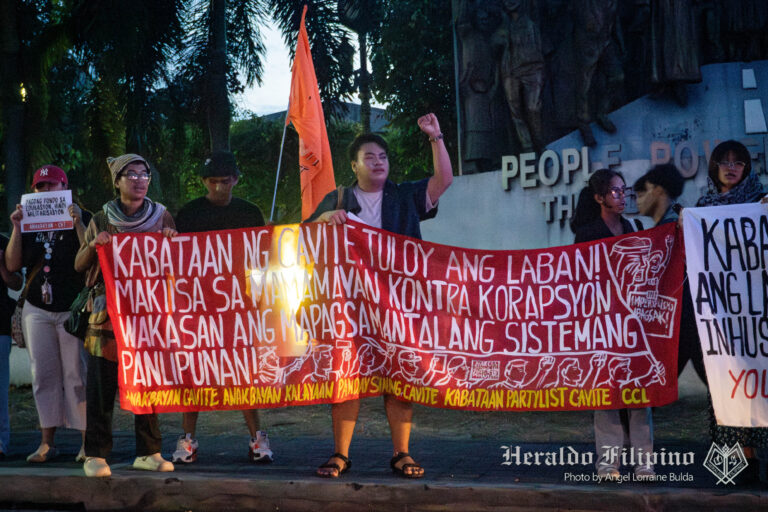
What began as routine coverage for Dominick Guzman, a De La Salle University – Dasmariñas (DLSU-D) student, and two independent journalists from Kilusang Setyembre Bente Uno (KS21), quickly unfolded into a tense encounter on November 30 during Baha sa Luneta 2.0, when unidentified police officers approached and later detained them at the Bonifacio Day mobilization.
Guzman said they first noticed strangers taking photos of them from a distance, giving the impression they were being monitored.
“We see people from a distance taking photos of us ganiyan, pero ‘pag natingin kami, at saka sila nags-stare away,” recalled Guzman, noting that surveillance began even before they arrived at the mobilization.
Later on, the independent journalists—clad in Kevlar vests, helmets, and balaclavas—were confronted by two men, one in a white shirt and the other in black, who questioned them about the supposed illegality of their protective gear in Manila.
The men claimed to be Philippine National Police (PNP) officers but failed to present badges.
Guzman acknowledged the risks of covering mass gatherings, but the confrontation made the danger feel immediate—especially when the men repeatedly questioned their right to document the mobilization.
“That guy won’t stop approaching us, keeps questioning us,” Guzman said, referring to the individuals who approached their van without showing identification.
The exchange left the journalists feeling harassed. The men accused them of violating Manila ordinances by wearing bulletproof vests and balaclavas. However, Guzman said the gear was for safety and to reduce the risk of red-tagging—of being branded as “manggugulo.”
A pattern of harassment beyond Luneta
Guzman’s experience is not isolated. Media workers nationwide continue to face obstruction—a pattern press freedom advocates say undermines democratic accountability.
One example is the ongoing case of Frenchie Mae Cumpio, the Executive Director of Eastern Vista and a journalist of Altermidya Network, arrested in February 2020 on non-bailable charges related to firearms, explosives, and alleged terrorist financing.
In September 2024, a Manila Today reporter covering a protest in Malolos, Bulacan, was harassed and threatened by unidentified assailants—an incident condemned by the International Federation of Journalists (IFJ) and its local affiliate.
During the 2025 elections, the Presidential Task Force on Media Security (PTFoMS) investigated multiple reports of intimidation and attacks against journalists covering election-related events.
Against that backdrop, the Luneta incident, says Guzman, revealed how vulnerable independent and student journalists remain when navigating heavily policed demonstrations.
Tension deepens at Luneta
Hurrying towards their spokesperson Johnny Tilar—who also reported being surrounded by police—the three encountered heavily armed personnel in black uniforms, units they could not clearly identify.
“Hybrid pulis sila… naka-itim, hindi ko alam kung SWAT sila or something,” Guzman recounted.
Instead of routine verification, he claimed officers provoked Tilar and attempted to coerce them. Footage shown to The HERALDO FILIPINO in an exclusive interview captured officers shouting and aggressively engaging with KS21 members until all three were forcibly taken to PNP Ermita.
Despite wearing visible press patches and carrying documentation gear, they were detained without clear explanation or charges. At the station, the three were questioned about their identities, affiliations, and purpose for attending the mobilization.
“May dahilan kami bakit naka-helmet at naka-protective gear… last time, may nasaktan sa amin dahil sa barilan at riot,” Guzman explained, stressing that their equipment was a necessary precaution.
Despite assurances that their personal information and images would not be released, Guzman later found multiple media outlets—GMA, ABS-CBN, and TV5—waiting to interview them outside the station.
“Paglabas namin, ando’n lahat ng media. Tapos may nakita pa kaming article sa Cotabato na may pangalan namin, kahit sinabi sa amin na walang lalabas,” he said, adding that the experience echoed long-standing accounts of state intimidation—except this time, he was living it.
Footage in question
What troubled Guzman further was discovering that a video of them taken earlier by an unidentified “authority” was already circulating among police and media agencies.
“It doesn’t make sense kasi if that guy na walang badge na maipakita… tapos no’ng tinanong namin ‘yung media saan nila nakuha ‘yung footage na ‘yun… sinabi nila galing sa PNP,” he said, suggesting the possibility of coordinated monitoring.
Adding to the confusion, some reporters at the scene questioned the legitimacy of independent press work, insisting journalism required a “license”—a claim debunked by their lawyer.
“Sabi nila mga vloggers daw kami… There is no such thing na kailangan ng license for journalism,” he asserted.
As the incident spread online, Guzman said he became the subject of speculation fueled by disinformation.
“Nakikita ko mukha ko sa internet buong araw… may nagsasabing NPA (New People’s Army) daw ako,” he shared, describing how the exposure alarmed some relatives and caused misunderstandings among his immediate social circles.
Needless to say, the incident took an emotional toll on him and reshaped how he approaches field reporting. Although his parents remained supportive—so long as he returned home safely—he admitted to becoming more cautious..
“Pero next time, baka ‘di na ako sumama sa rally coverage… baka community stories na lang muna,” he said, revealing a shift many reporters grapple with: balancing passion for truth-telling with the realities of harassment, public scrutiny, and personal well-being.
A deeper concern: press freedom at risk
Reflecting on the ordeal, Guzman said the Luneta incident felt less like a one-off disruption and more like a symptom of a deeper structural problem.
“Para sa akin, tyrannical talaga… nasu-suppress ‘yung freedom of press… Ginawa namin trabaho namin, pero tinrato kami na parang may ginagawang masama,” he said.
For him, what happened that day exposed how easily authorities can blur the line between maintaining order and suppressing those who document it. It served as a sobering reminder that protest coverage is no longer just about capturing stories or providing public visibility to civic action. It now involves negotiating with layers of bureaucracy, navigating checkpoints of suspicion, and asserting their right to report in spaces where the presence of a camera can be treated as a liability.
What should have been routine coverage became a confrontation underscoring an unsettling truth: the freedom to document, question, and witness—the very foundations of journalism—is increasingly filtered through the discretion of authorities who decide who may stand behind the lens and who must be kept from looking.
***
Manila City’s Anti-Balaclava Ordinance (City Ordinance No. 9134), implemented on November 3, 2025, restricts the use of face-covering gear such as balaclavas, masks, and certain helmets in public places as part of the city’s crime-prevention policy.
Originally published in Heraldo Filipino Volume 40, Issue 1.