RECENT PUBLICATIONS |

The Co(a)st of Progress
As development projects continue to reshape Bacoor, Cavite’s coastline, communities fear they may lose not only their homes but also the livelihoods that have sustained their families for generations.
The first impression of Bacoor’s coastal communities was not the threat of demolition, but the life that continued despite uncertainty.
Children ran through narrow pathways between homes. Neighbors gathered outside, exchanging stories and laughter. In some corners, groups of men shared drinks while singing karaoke inside bamboo houses standing above the water. Fishing boats remained tied along the shoreline, waiting for their next trip to sea.
At first glance, Talaba II and Longos looked like any other close-knit coastal communities. But signs of uncertainty were impossible to ignore.
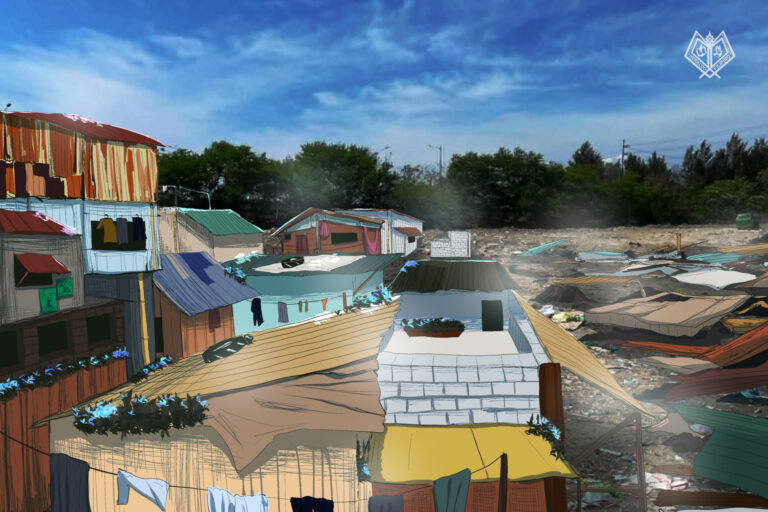
Some portions of the coastline had already been cleared, leaving stretches of flattened land where homes once stood. Just a few steps away, families continued their daily routines, living with the uncertainty of not knowing when—or if—they, too, would eventually be asked to leave.
Residents attribute the demolitions to several projects planned along Bacoor’s coastline, including the extension of the Light Rail Transit (LRT), the proposed Bacoor–Naic diversion road, and reclamation activities linked to private companies seeking to develop portions of the coastal area and the sea itself.
Now, residents do not just worry about losing the place they have called home for years—they also fear losing the same waters that have long sustained them.
Life tied to the sea
For more than three decades, fisherman Herbert Benosa has called Bacoor’s coastline his home, where the sea has long served as the primary source of income for his family and countless others who have built their lives around fishing.
As discussions of relocation continue amid the looming threat of demolition, Benosa fears that moving away from the shoreline would mean more than leaving behind a place to live—it would also separate residents from the only livelihood they have known for generations.
“Eh kung ililipat lang naman kami, huwag naman sa malayo. Mandaragat kami eh. Kung saan may dagat, doon kami,” Benosa expressed.
Across interviews, residents shared the same concern: relocation may provide housing, but not necessarily a livelihood.
According to them, many families who had previously been relocated eventually returned to Bacoor because they could not sustain themselves elsewhere.
“Dito na talaga namuhay ang tao, dito na namulat, at dito na nakasanayan maghanapbuhay,” Benosa recalled.
Leone, who has lived in the community for two decades, echoed the same sentiments.
“Mahirap po kung mangungupahan ka kasi hindi po kayanin. At saka mahirap makahanap ng paupahan na tatanggap sa maraming miyembro ng pamilya,” she said, recalling the difficulties of living away from the coast and why her family eventually returned.
The same challenge confronted Tatay Rick, a fisherman who was relocated to General Trias, where his housing unit is about 45 minutes away from the sea.
“Wala kami hanapbuhay sa General Trias, hindi siya tabing-dagat… sa General Trias daw maghahanap [ng] trabaho, eh paano ‘yun, matanda na ‘ko, tatanggapin pa ba ako nila? Hindi na,” he said.
Their experiences reflect the challenges coastal families face when housing programs are built far from the sea, where their livelihoods have depended for years. For them, the sea determines where life begins and ends.
Left behind
For some residents, however, the problem is not that relocation sites are too far away, but that they have not been offered relocation at all.
For Leone, relocation has remained less a solution than an unanswered promise. After losing her home in a fire and spending months in evacuation centers and rental housing, she eventually returned to rebuild her home near the shoreline.
“‘Yung binigyan lang talaga nila ng relocation ay ‘yung nasa LRT. Pero kami po, mismong nasa dagat kami. Hindi naman kami naisama. Ang sabi, ‘yung pangakong relocation ay na-postpone naman. Hanggang sa sinabi na lang na wala raw para sa mga nasa dagat,” Leone said.
She described the months of uncertainty as a cycle of paperwork and waiting—submitting requirements repeatedly, only to receive little clarity about what would come next.
Housing programs that required loans and down payments felt far beyond reach for families already struggling with displacement and unstable income.
Without relocation assistance, many residents believed they had no choice but to remain in the communities where they had spent most of their lives.
For them, remaining near the shoreline is not simply a preference—it is an economic necessity.
Progress for whom?
New roads, railway extensions, and large-scale development projects promise to transform Bacoor in the years ahead. To many, these projects represent progress—faster transportation, new business opportunities, and a more modern city.
Along the shoreline, however, that promise comes with a different reality.
What is presented as progress for the city has become a source of uncertainty for families who do not know whether they will still have a place in it.
Benosa believes the continued threat of demolition is tied to bigger plans for the area.
“Siyempre, ‘pag dinemolish ang isang lugar, may balak sila diyan. May proyekto silang gagawin diyan, maaaring commercial,” he said.
Residents do not necessarily oppose development itself. Many understand the need for infrastructure and modernization. What troubles them, they said, is the feeling that the people most affected by these projects are often the ones asked to make the biggest sacrifices.
“Hindi mo alam kung kailan ka gigibain, kung kailan ka paaalisin,” Leone said.
That uncertainty affects everyday life. Some residents hesitate to make improvements to their homes because they fear they may eventually be forced to leave. Others continue living with the possibility that years of work invested in their homes and communities could disappear with little notice.
Message to the government
Years of uncertainty have left residents with more questions than answers.
Their frustration no longer comes only from the threat of demolition itself, but also from promises that never fully reached them and decisions that were made without their voices.
“Dapat kung ano ‘yung sinabi nila, ginagawa nila. Hindi ‘yung ginagawan nila ng kasinungalingan na ganito-ganyan,” Leone emphasized.
Here, a house is inseparable from a livelihood. A relocation site may provide walls and a roof, but it cannot easily replace a fishing boat tied along the shoreline, a day’s catch sold within the neighborhood, or decades of knowledge passed from one generation of fishermen to the next.
“Kung papipiliin kami, tanungin nila kami kung saan namin p’wedeng ilipat. Tanungin dapat nila kung saan kami maalwan, hindi ‘yung kung saan-saan itapon. Parang wala kaming karapatan,” Benosa stressed.
Residents say they are not opposed to progress. What they fear is becoming invisible within it. They are not simply asking where they will live. They are asking whether they will still be able to work, provide for their families, and remain part of the communities they have spent much of their lives building.
For generations, the shoreline has been more than an address. It has been a workplace, a marketplace, and a community. As Bacoor’s coastline continues to change, residents hope that the future being built around them will still have a place for the people who have long called the sea their home. They hope that when authorities create a “vision” for a better Philippines, marginalized communities will not be treated as hindrances, but as people who deserve a place in it as well.
Art by Allenson Esteban
Originally published in Heraldo Filipino Volume 40, Issue 2