RECENT PUBLICATIONS |

USG: Unconstitutional Student Government
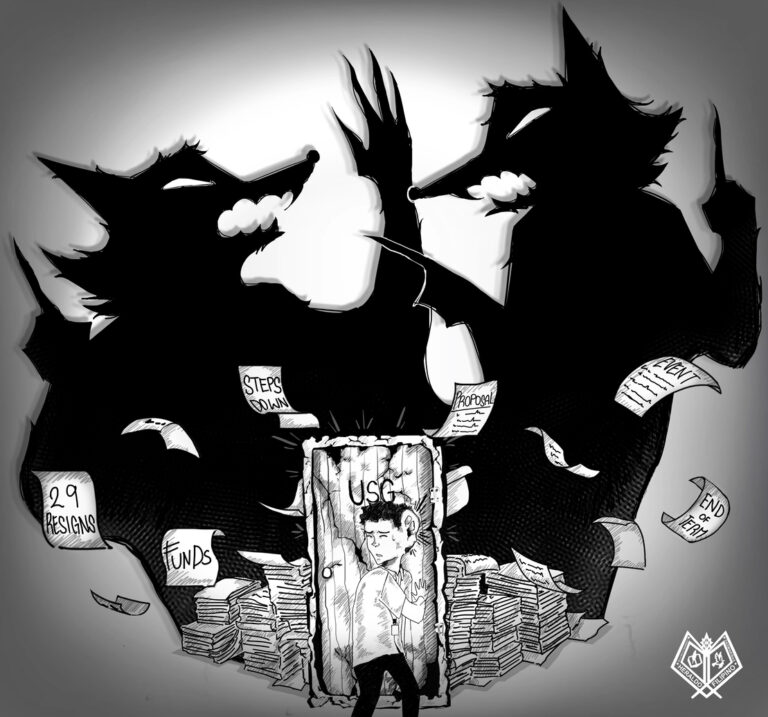
For the student body, the close of the first semester came with a leadership crisis that challenged the face of student representation—one being that of a whole fiasco involving its highest student governing body, the University Student Government (USG)’s 7th Congress. Students were met with silence, speculation, and decisions they had no part in shaping.
It should not have been the case.
Throughout the semester, rumors of persistent resignations within USG’s Executive Branch surfaced, yet no formal public address was issued. The student body was left to piece together developments on its own, until former USG President John Andrei Vito ultimately resigned on December 2, after an impeachment case was filed against him. Only then did it become known that about 29 officials had tendered their resignations—an unprecedented occurrence in the University’s history.
16 days later, on December 18, Erin Jozel Madlangbayan—herself among the 29 officials who had filed for resignation—formally assumed office. No heads up whatsoever, just straight to the presidency.
The problem is not that leadership transitions occurred; it is that students were excluded from the process entirely. There was neither prior public disclosure addressing the scale of the crisis nor explanation of how the line of succession was applied. No opportunity for students to be informed, much less involved. It was as if there was no elephant in the room.
Looking at the USG Constitution, this should not have been the case. This lack of transparency—from the onset of resignations to the appointment of a new president—raises questions anchored on the provisions of Article II, Section 14 and 15.
Section 14: “The University Student Government shall encourage the involvement of the students in university, public, and civic affairs.”
Section 15: “The University Student Government adopts and implements a policy of full public disclosure of all transactions involving student interest subject to the reasonable conditions prescribed by law and regulations in the university.”
Leadership transitions triggered by mass resignations are undeniably matters of student interest. Yet there was no disclosure of how decisions were reached, no consultation with the student body, no explanation of the succession process. Students were simply presented with results.
The constitutional ambiguities surrounding Madlangbayan’s assumption of the presidency only deepen these concerns. While Article XII, Section 7 outlines the constitutional order for assuming the presidency, its application was not clarified. The now-sitting president had previously filed her resignation alongside 28 others—then apparently revoked it. When did this occur? Through what process? On what legal basis? These questions remain unanswered.
Further complicating matters is the role of the Executive Secretary, the supposed highest-ranking Cabinet left after the resignations. This office is not enumerated in the 2019 Constitution’s original Cabinet structure, raising questions about whether the position was considered for the presidential succession—and if so, why it was bypassed without explanation.
What is perhaps most concerning is the repeated framing of the crisis as merely an “internal conflict” or a matter of leadership style. This is deflection, not accountability. When officials resign claiming they can no longer align with the administration’s governance, yet offer no specifics to the students they serve, that is not principled resignation. When the house is on fire and you save yourself while students are left in the dark, that is abandonment of duty.
The resigned officials were still in positions of power when these problems emerged. They had the authority to implement change, to demand transparency, to protect the integrity of the institution. Instead, they left. And in leaving, they failed to ensure that their departures would not create the very opacity they now criticize.
Madlangbayan’s address upon assuming office contained no acknowledgment of transparency failures during her time as an Executive Branch official. No recognition that she was part of an administration that kept students uninformed. No assurance that her presidency would rectify these constitutional violations. The message seemed to be: the previous administration failed, and I am here to fix it—without acknowledging that she was part of that very administration until the moment she became its leader.
These were the lapses under Vito’s administration. However, the installation of a new president does not close the issue; rather, it opens a new responsibility. They now carry the obligation to correct what was mishandled. This second semester presents an opportunity not for damage control, but for reform. Ultimately, the USG has failed the students, and with the new administration, it must not continue to do so.
It will take time for the USG to restore trust, but this begins with a firm commitment to full public disclosure, especially in matters of leadership and governance. Clear institutional mechanisms for transparency must be established, not left to the discretion of individual officials.
Ultimately, this crisis underscores the urgent need to revisit and revise the USG Constitution. Structural gaps in succession, appointments, and Executive Branch composition must be addressed to prevent future ambiguity. A constitution that fails to evolve alongside governance cannot sufficiently protect student democracy.
As the second semester begins, the expectations are clear: The failures of the previous administration must not be repeated. Transparency must no longer be optional. Accountability must no longer be reactive. Student involvement must no longer be an afterthought. Constitutional neglect must end here.
The USG exists to serve students, not to operate in isolation from them. When officials treat student governance as their private domain—when they make decisions affecting thousands without disclosure, consultation, or accountability—they violate the fundamental contract between representatives and the represented.
The students are watching, and they deserve better.