RECENT PUBLICATIONS |

Everyone’s An Actor: The Performative Fe/Male Phenomenon
Performative behaviors are far more common than we realize. In fact, we have witnessed versions of them our entire lives. It’s the friend who pretends to love things they don’t even like that much, the mother who insists everything is fine despite chaotic realities at home, or even ourselves—those times when we feel compelled to feign interest in things we are not, or adopt a personality that doesn’t quite belong to us.
The aesthetic of inauthenticity
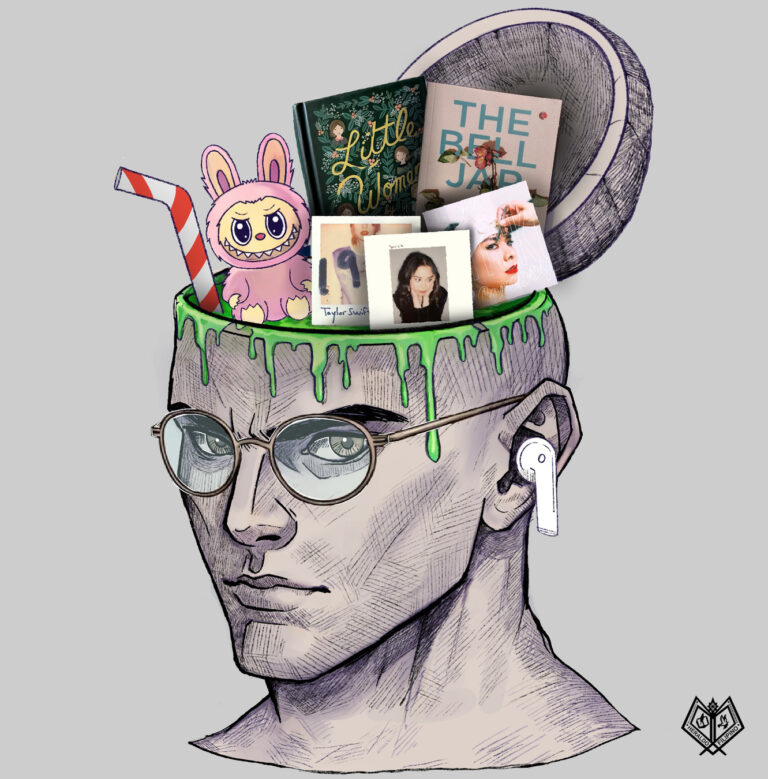
A matcha latte sweating onto a café table. A Labubu plush clipped to a tote bag. A paperback of feminist theory placed just inside the frame of an Instagram story.
What comes to mind when you hear the word “performative?” The internet has turned it into a collection of recognizable material signals, carefully curated aesthetics that announce identity before a word is spoken.
This figure flaunts certain interests and objects not out of genuine curiosity, but as social currency. The essence of being performative lies in prioritizing the signal over the substance. While “performative” may function as a modern synonym for “disingenuous,” the way these traits are bundled suggests something more calculated—a deliberate effort to be perceived rather than truly known.
Built for the eyes
The question that lingers are: Why does someone feel the need to mask themselves and present an image that isn’t entirely authentic? What drives a person to curate their interests, aesthetics, and personality into a performance?
Attempting to answer this definitively would require formal psychological study. Still, we don’t need a laboratory to recognize familiar patterns. Social psychologists have long described behaviors like impression management—the way people curate how they are perceived—and validation-seeking, the desire for affirmation from others. A performative lifestyle can be understood through these lenses: not necessarily as deception, but as strategic self-presentation in a culture where identity is constantly on display.
The question, then, is not whether people are “faking” who they are, but what incentives encourage this kind of presentation in the first place.
The simplest explanation for the rise of the “performative male” is attraction—not just to people, but to attention, approval, and cultural capital. Some commentators argue that adopting certain aesthetic signals can function as a form of impression management, a term social psychologists use to describe how individuals curate their public persona to influence how others see them. In the context of online culture, presenting an image designed to appeal to certain audiences, including women, becomes only one plausible motivation among many.
To understand this better, it helps to break down the elements that make up the archetype now circulating online. Take Labubu, a collectible blind-box plush that women often showcase as a fashion accessory and symbol of playful self-expression. Then there are matcha-flavored drinks, once niche but now elevated into a marker of cultural taste. Finally, there’s feminist literature—a visible signal of social awareness and ideological alignment.
Individually, none of these interests are unusual or inherently performative. What is striking is how some individuals assemble these elements into a coherent set of signals, deliberately shaped for public consumption. Seen this way, the trend resembles what cultural theorists describe as a language of identity, a set of symbols people use to communicate belonging, values, and desirability within a given social milieu.
The art of appearing intelligent
While some “performative males” may adopt certain aesthetics in hopes of romantic appeal, attraction is not the only possible motivation. For others, these signals function as markers of class, taste, or cultural capital. Aligning oneself with feminist literature, left-leaning politics, or niche musical artists can communicate social awareness and intellectual engagement—qualities that carry value in many contemporary spaces.
The issue is not the interests themselves. Reading feminist theory, enjoying artists like Taylor Swift, beabadoobee, Laufey, or Mitski, or engaging with progressive politics does not automatically signal performativity. What becomes notable is when these elements are assembled and emphasized primarily as identity markers—when cultural consumption shifts from private enjoyment to public alignment.
In this sense, performativity is less about ideology and more about presentation. It is the difference between holding beliefs and curating them for visibility. When media choices and political affiliations are foregrounded as proof of moral or intellectual distinction, they begin to function less as personal interests and more as social signals.
The archetypes
I’ve listed the leading reasons as to why performative males even feel the need to perform, but let’s take a dive into its history. The habit goes deeper than the trend we see today. In fact, it’s been happening for years. We just never put too much thought into it because it did not become this much of a huge meme. One of the earliest examples is the “pick-me,” someone who insists “I’m not like others ___s,” in an attempt to appear more desirable or unique. Yes, it is very much the same act: putting on an image that differentiates you from others. We just used a different label.
The common thought process for someone who performs is: “I must put on this image so they’ll have a more positive opinion of me.” It’s a variant of the “people pleaser” archetype. They want to be loved by everybody, and the attention of others is what gives them a sense of security. While not inherently a negative trait to possess, it points to problems with self-image and authenticity.
Most performative people struggle with poor self-image. They use these practices as a way to cope. The idea of being loved for their curated images becomes satisfying, and they grow dependent on it.
***
In the end, it wouldn’t be wise for anyone to twist their image into something they’re not. Forcefully curating tastes into something you don’t genuinely care about may earn attention, but it comes at the cost of authenticity. It would be great if people could just be themselves. After all, the people who are genuine are much more likeable than those who wear a mask and pretend. The real performance ends when you stop acting for an audience and start living for yourself.
Art slider by Alexandra Asuncion