RECENT PUBLICATIONS |


The [UN]safe space
There is a specific kind of discomfort that comes from watching someone in power say something they shouldn’t, and then watching everyone around them decide whether or not to pretend it didn’t happen.
That was March 3, 2026. That was on National Women’s Month. That was the House Committee hearing. That was Rep. Bong Suntay describing, in detail, a “desire” that “welled up” while imagining actress Anne Curtis at a mall—offered up, apparently, as a legal analogy. The room did not stop. The cameras kept rolling. And somewhere in that silence, a line that should have held simply didn’t.
Becoming the plot twist
Objectification. These six syllables can set off alarm bells in any conversation between women and the institutions supposed to protect them. During the March 3 House Committee hearing, United Nationalist Alliance Rep. Suntay attempted to illustrate a legal point by describing what he felt while imagining the actress at a mall. For many, it was a moment where the orthodoxy of political debate unraveled into something much more predatory. The defense came just as it was expected: it was “just an analogy,” a thought experiment that surely couldn’t harm anyone. Yet, as GABRIELA Rep. Sarah Elago and other advocates quickly pointed out, using a woman’s personhood as a prop for a male argument is not merely a legal nuance but a public act of objectification.
Amid the noise of the political fallout, there is a singular truth. While the lawmaker eventually apologized, stating he “deserved the backlash,” the damage was already mapped. It wasn’t just about one actress; it was about every woman who has sat in a public space and felt the “heat” of a gaze or a comment that reduced her to a hypothetical object. It was a reminder that even in the highest offices, stepping away from the script of equality reveals whose dignity society truly values.
The long route of everyday suffering
There is a strange kind of clarity that comes when you strip away the celebrity names and look at the statistics of “everywoman.” For many who encounter casual sexism, the experience isn’t just a one-time headline but a continuous navigation of quiet microaggressions. Research indicates that Filipino women experience an average of one to two sexist incidents daily, ranging from lewd “jokes” to intrusive staring.
In these moments, the noise of the world quiets for the men making the jokes, but for the women receiving them, the echo is deafening.
“You learn to develop a hearing filter,” says Maya, a 22-year-old student leader. “Kung ang professor o ang kaklase mo makes a ‘what if’ comment about your body or your ‘imagined’ reactions, hindi ka sisigaw eh, you just freeze. Tinatantya mo ‘yung magiging cost ng pag-speak up mo versus sa cost ng magiging grades mo or ‘yung reputation mo.”
This “silent tax” is the heavy psychological price of constant objectification.
There is a bitter irony in a lawmaker turning a woman into a prop in the same hall where the Safe Spaces Act was born—proving that while our laws have modernized, the “imagination” of those in power remains prehistoric. We don’t want a pedestal; we want the right to walk through a room without our dignity being used as a rhetorical device.
These moments of “everyday suffering,” become catalysts for a hidden mental health burden, consistently linked to increased rates of anxiety and a lower sense of safety in professional environments. In the unpredictability of a workday—the unexpected comment, the unplanned sexualized detour in conversation—women are forced to ask, “What makes me safe here?” It is a question that our institutions, with their constant push toward “efficiency,” rarely give them the space to explore.
After pressing pause on sexism
For women in the workforce, the “Anne Curtis incident” wasn’t just a viral clip; it was an echo of a familiar exhaustion.
“Nu’ng nakita ko ‘yung hearing, I didn’t see a congressman,” shares Elena, a third-year civil engineering student. “I saw every adult who ever told me that I should ‘take it as a compliment’ whenever someone with a higher standing makes a lewd remark. From there, nakikita ko ‘yung systemic permission na we give men to treat our existence as a thought experiment.”
The bitter irony of the Suntay case is that it happened in the halls where the Safe Spaces Act (RA 11313) was authored. The Philippine Commission on Women (PCW) clearly expressed that such remarks constitute a serious betrayal of public trust. The shift in perspective must be profound; we must learn that respect, not “imagination,” should drive our public discourse.
Yet, this essential need for accountability did not go unnoticed. When an ethics complaint was filed within 48 hours, it signaled that the public is no longer driven by the old scripts of tolerance. Even the representative’s own wife, Shiela Guevara-Suntay, publicly stated that “no woman should ever be spoken about that way,” which suggests that real stories of growth come from standing against objectification, even when it’s close to home.
What starts as a “hypothetical” analogy often becomes a journey with no clear end for the culture it reinforces. As we face another cycle of news winding down, drowned by other sorts of discourse, and the familiar structure of political life takes its place once more, we are left with a heavy question: have we actually changed, or are we just better at apologizing?
***
This incident is a mirror. It reflects a society that has learned the vocabulary of safe spaces while the underlying assumptions—about whose comfort matters, whose imagination gets to roam free, whose dignity is negotiable—remain largely intact. But the response, from women who have been keeping the math in their heads for years, suggests the mirror is starting to crack.
The demand is not complicated. It is not radical. It is simply this: that a woman should be able to walk into any room—a hearing, a classroom, a jeepney—without her personhood becoming raw material for someone else’s analogy.
Not a premise. Not a prop. Not a hypothetical.
Just a person, arriving.
That’s all. That’s the whole thing.
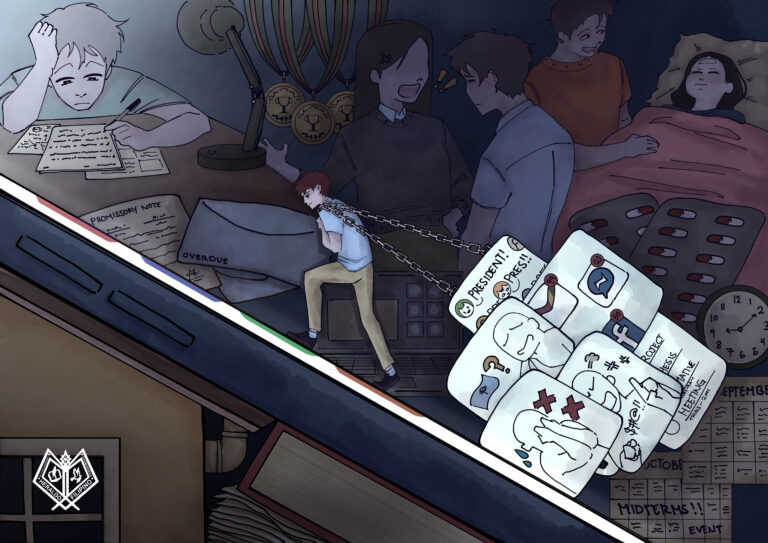
Graphic Art by Jeremy Ray Milca