RECENT PUBLICATIONS |

First to listen, Last to recover
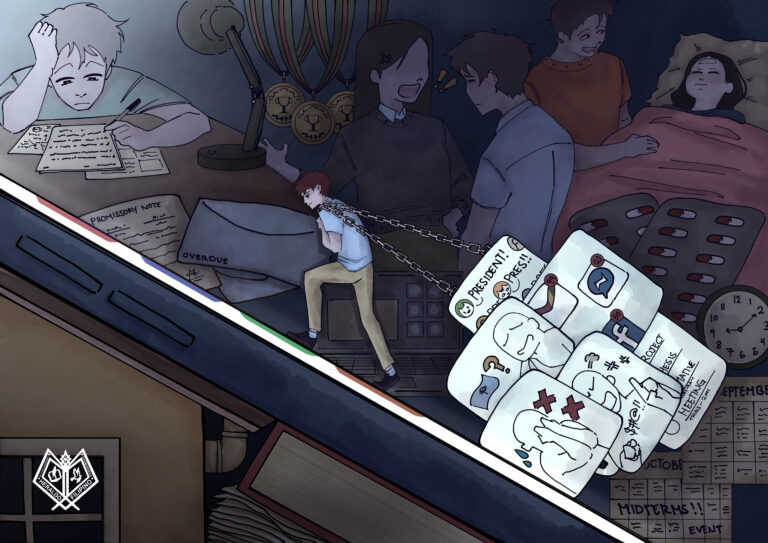
It usually starts with a phone lighting up at 2 AM.
A message arrives, its chime breaking the quiet of the room, where tomorrow’s class is only a few hours away and there are still readings to finish, slides to review, or a paper waiting to be submitted.
Sometimes, it is only a few words. Sometimes, it is a long message that takes a while to process. On rare occasions, it is a phone call—and on the other end is someone who does not know who else to reach.
So you answer.
You tell yourself you will stay on the line for a few minutes, listen, and let them talk without interrupting because whatever they are carrying feels too heavy to cut short. The minutes stretch into an hour, then two. You tell yourself a review session can wait. Sleep can wait. Your own worries can wait. For a while, the only thing that matters is ensuring the person on the other end of the phone is still there.
Then the call ends.
The room is quiet again, but the night no longer feels the same. You wonder whether they are really okay. You check your phone continuously. You think about whether you said the right thing, whether you should have stayed longer, or whether you should have done something more. Tomorrow still comes whether you are ready for it or not, and you have to carry yourself into class with a lingering weight from last night’s conversation somewhere in the back of your mind.
On a campus where students are constantly encouraged to look out for one another, looking out for a friend often means becoming the person who stays awake with them, listens when everyone else is asleep, and tries to make sense of something they were never trained to handle. These students are not counselors nor therapists. They are not trained to carry another person’s worst night. They are simply peers whom someone trusted enough to call—and sometimes, that trust can carry a heavier toll than they expected.
The person at the other end of the phone
For Nina Marience Soriano, a fourth-year Civil Engineering Student, being there for someone begins with listening. When a friend reaches out late at night, her first instinct is concern—“Safe ba ‘to ngayon?!”—followed by a conscious effort to stay calm. She avoids rushing to offer solutions or pretending she understands everything. Instead, she offers presence and validation, trying to make sure they know they are not facing the moment alone.
However, Soriano has also learned that presence alone does not fix everything. She recognizes when she is emotionally drained, and knows that she has to step back. For her, establishing boundaries does not mean caring any less or abandoning someone. Rather, it acknowledges that she has limits, and understanding that being a good friend also means taking care of herself.
That distinction becomes harder when the person on the other end is someone she knows is struggling deeply. Soriano admits that she has wondered, “What if something happens to them habang hindi ako nandyan?” The fear can make stepping away feel like an avoidance of responsibility—even when she recognizes that another person’s choices and well-being cannot rest entirely on her shoulders.
“I can care for someone deeply without being responsible for every decision or outcome in their life,” she reflects.
It is a boundary that sounds simple in principle, but grows complex when the phone rings at the wrong hour, when the person calling is someone you love, and when the guilt of leaving a call unanswered feels far heavier than the exhaustion of picking up.
When being the one who answers becomes a responsibility
Roxanne Emmanuelle Asogue, a fifth-year Accountancy student, understands the feeling well. Peers have come to know her as a dependable source of support—in the classroom, within her campus organization, and beyond the University. When someone reaches out in distress, her first reaction is often a quiet “hala,” quickly followed by the question of how to handle what has just been entrusted to her.
She understands how much courage it can take for someone to finally reach out. Yet that very empathy can make saying no even harder, driving her to respond even when it is difficult.
“They describe me as someone who is always there for everyone,” Asogue says. “It takes a lot in me to say ‘no’ din.”
For Asogue, recognizing her limits means understanding how much she can carry before trying to care for another. She describes it as knowing the capacity of her own “plate”—a measure of how much pain and difficulty she can only hold before running out of room. When she reaches that edge, she tries to be honest without leaving the other person feeling abandoned.
Because sometimes, the hardest part is not the act of listening. It is accepting that you cannot be everything someone needs.
The secrets you were never meant to carry alone
When a struggling friend asks for secrecy out of fear of being judged or misunderstood, the peer listening is pulled in opposite directions of trust and safety. What do you do when someone’s trust crosses the line to a situation that may already be beyond what you can safely handle?
For Soriano, the answer is uncomfortable but clear: if someone’s safety is at risk, she would rather face their anger than live with the possibility that silence could have allowed something worse to happen. Furthermore, Asogue echoes this view, especially when mental health struggles carry a persistent stigma and seeking professional help seems complicated. Sometimes, the problem is not just convincing someone to seek help, but helping them navigate that fear, hesitation, and all the reasons that prevent them from reaching out in the first place.
“It’s not my story to tell,” Asogue says of sharing another person’s private struggles.
Yet, respecting another person’s story does not mean keeping it between two people. When safety is compromised, the responsibility must move beyond the student who happened to be trusted first.
Because sometimes, it is 2 AM
It becomes harder after midnight. At one or two in the morning, a student in crisis may not be thinking about office hours or administrative availability—they are reaching for whoever feels safe enough to call. More often than not, that person is another student who should be sleeping, studying, or preparing for class.
Maria, a fourth-year Multimedia Arts student, knows what that can look like. She has answered calls around 2 AM, despite having classes or an examination the following day. Sometimes, she stays on the line for two or three hours—setting aside studying until nearly 3 AM because someone needed her to stay.
Her first thought in those moments is simple: “I need to make sure she’s okay.”
The rest of the call is far less certain. She worries about saying the wrong thing or missing something important, panicking internally while trying to sound steady. Even after the call ends, the concern lingers. She finds herself checking whether the person is online, wondering if they are okay, and carrying the conversation into the next day.
“It’s not just the time you spend talking to them. It’s what happens afterward,” Maria explains.
The student who answered is expected to function as a student afterwards. There are classes to attend and assessments to accomplish, with no visible marker that they spent the previous night trying to keep someone else from falling apart.
For Maria, the aftermath can become difficult to separate from her own emotions. “And eventually, their problem becomes something you’re carrying with you.”
She admits to feeling guilty when she considers ignoring a call, convincing herself that her own emotions had to come second because someone else was having a harder time. There have been nights when she cried because she was emotionally exhausted after hanging up.
“People come to me because they think I’m someone who knows what to do,” Maria says. “But when I’m the one who needs help, I don’t always know who to talk to.”
The expectation to always know what to do can make the burden heavier. A student can be someone else’s safe harbor while having nowhere to place their own fear, exhaustion, or uncertainty.
Someone has to stay with the one who stayed
This is where institutional systems must step in.
Agnes B. Gibas, MAEd, Director of the Student Wellness Center (SWC), points out that while students may be the first people to notice when something is wrong with their peers, friendship has limits that must be respected when someone’s safety is at risk.
“Iba naman ‘yung capacity mo as a friend,” Gibas emphasizes.
A student can stay and offer a listening ear. A student can encourage a friend to seek professional guidance. But in serious situations, that responsibility should not remain on one student’s shoulders.
The SWC encourages students to seek professional support when a situation escalates beyond what a friend can safely manage. When a peer poses an immediate danger to themselves or others, confidentiality must yield to safety—not to violate trust, but to make sure they are connected to someone equipped to help. Students can also reach out to trained Lasallian Peer Facilitators (LPFs), who can assist in identifying mental health concerns and facilitating center referrals.
That support should extend to the referring student as well. Gibas reminds student responders to “detox” after taking on heavy accounts and make space for their own recovery, acknowledging that even responders can become emotionally depleted.
The SWC emphasizes that mental health and suicide prevention is not the sole jurisdiction of a single office or profession. “It is a unified work for all,” Gibas shares—a shared responsibility that calls on students, faculty members, mental health professionals, families, and the wider University community to actively watch out for one another.
Support, however, must also be accessible when students are already struggling to ask for it. Asogue points to an initiative within the College of Business Administration and Accountancy (CBAA) that allows students to request an absence or leave of absence on mental health grounds, which she considers a step in the right direction.
Yet, she notes that utilizing the provision still involves administrative hurdles during moments of acute distress.
“So many papers na need ipasa,” she says. “When you’re in that kind of situation na, alam mo ‘yun, down ka na, and you’re at the last end of your straw, you’re not going to be thinking about passing those papers.”
When someone is already at their lowest, proving their struggle can feel like another task they simply cannot manage. The initiative may recognize the validity of mental health concerns, but Asogue hopes the process can eventually become less burdensome for the students it is meant to support. The concern is not the existence of the policy, but whether a student in their most vulnerable moment can realistically navigate it.
If suicide prevention is truly a shared responsibility, then making help accessible also means making sure students can realistically reach it when they need it most. That means removing unnecessary barriers that may keep a struggling student from seeking support, while also making space for the peers who made the first call and may be carrying the weight of what happened afterward. Support should not end with the person in crisis; it should also reach the people who stayed.
[…]
Soriano has learned that stepping back when she is exhausted does not make her less of a friend. Asogue has learned that self-regulation is part of caring for others without losing herself in the process. Maria is learning that being available does not mean she has to be available at all times.
Their experiences differ, but they meet the same difficult truth: students can care deeply for one another without the sole burden of saving one another. You can answer the phone without surrendering your entire life. You can listen without pretending you have all the answers. You can love someone and still have the courage to say, “I can’t do this alone.”
Suicide prevention is not about a single person carrying another through their darkest moment—it is about ensuring that no one has to carry it alone.
It requires knowing when to listen, when to step back, when to see institutional help, and when to pass the weight to those who are trained to carry it with you.
The phone may light up again. Someone may answer. But this time, they should do so knowing they do not have to carry what comes next alone.
If you or someone you know is in crisis, help is available. Reach out to a trusted person or contact the following support services:
DLSU-D Student Wellness Center
Local Line: +63 (46) 481.1900 local 3054
Manila Line: +63 (2) 8779.5180
Facebook: https://www.facebook.com/dlsudswc
DLSU-D Address: swc@dlsud.edu.ph
National Center for Mental Health Crisis Hotline
Toll-Free Landline (Nationwide): 1553
Landline / Alternative: 1800-1888-1553
Smart / TNT: 0919-057-1553
Globe / TM: 0917-899-8727 (USAP) or 0966-351-4518
Emergency Services
911
In Touch Community Services
Landline: +63 2 8893 7603
Globe: +63 917 800 1123 or +63 917 108 5412
Smart: +63 919 056 0709 or +63 922 893 8944
(Note: These numbers are for calls only and cannot receive text messages.)
If there is immediate danger, do not leave the person alone and seek emergency assistance.
Art slider by Francesca Angela Jores